

The capacity to perceive and modify musical qualities in service of a therapeutic practice.
This does not concern the mastery of a musical instrument or the learning of music theory. Neither does it's development depend on these.
Therapists often express a lack of enough knowledge and skill for the use of music. You may for example argue that you do not play an instrument, that you do not understand music theory, or more broadly that you do not understand music enough.
The reality is that these are not needed to develop the most fundamental skill needed for working with music therapeutically, which is the development of your musicality.
By developing your therapeutic musicality, this course is designed to improve your abilities to:
You will develop therapeutic musicality across the following axes:
From day 1 you are guided into new ways of relating with music. Both experientially and conceptually. You will be engaging creatively in a wide variety of listening experiences within your own setting.
The capacity to tailor your ways of responding to the dynamic needs of the present context.
This does not discard models, protocols, guidelines, but teaches how to appraise and apply them into the reality of your practice.
Therapists can fall in the trap of searching for components to copy-paste directly into their practice. You may for example follow a set of prescriptions to use for specific use-cases, or collect playlists made by others.
Although models and protocols have clear value, when applied too procedurally this can create a dissociation between therapist and client.
By growing new layers of modularity and flexibility, this course is designed to improve your ability to:
You will familiarise yourself with a number of models and frameworks that directory bridge theory with practice. Here are a few examples:
A variety of models and frameworks will be explored via the theory lectures and group discussions. These are combined with listening experiences and reflective exercises, aiming to make the teachings come most alive, relatable and translational to you and your practice.

The ability to hold distinct paths of meaning-making together simultaneously and inclusively.
This is not only about seeing value in different perspectives, but how they interweave as different expressions of the same phenomena.
Many tend to box themselves into one or a few orientations, typically determined by one’s education history. This however can become limiting when responding to phenomena that are intrinsically multifaceted and ambiguous – such as music and consciousness.
Using music therapeutically therefore invites an openness to a multitude of ways of being, listening, interpreting and relating.
By encouraging such integrative attitude this course aims to:
This course presents a number of perspectives on music, the self and the processes of therapy, that borrow for example from Evolutionary Theory, Culture Studies, Anthroplogy, Child and Human Development, Neuroscience, Complexity Science, Medicine & Psychiatry, Cognitive Sciences, Object Relations Theory, Somatic Psychology, Humanistic Psychology, Transpersonal Psychology, and more
These will be presented through teaching the following integrative frameworks:
This models and frameworks will be teached primarily via lectures, conversations fuse-case studies and additional reading suggestions, and will be synchronised with relevant experiential exercises.
This is not a course that you’ll just study, it’s one that you’ll embody
Whether through self-guided exercises or live group interactions: you’ll use music in practice from day one, including one month of playlist design workshops, where you’ll receive expert guidance and experience each others’ approach. This practice includes methods for preparing, personalising, sequencing, guiding, mixing, adapting, etc.
Practitioners who want to use music with more insightfulness, depth and impact
You’ll acquire a flexible framework that originates in psychedelic therapy research but is adaptable to various orientations. Within the course you will apply teachings directly into your own practice, guided by real-world examples, templates and collaborative learning groups.
To ensure accessibility across time zones, you’ll have the opportunity to choose your preferred times when registering.
⏱️ 45-90min
💻 Live and Recorded
⏱️ 5-60min
💻 Written and Recorded
⏱️ 60-120min
💻 Live only
⏱️ 5-60min
💻 Live and Recorded
⏱️ Every week from 19 March – 6 April
🧑🤝🧑 In triads and small groups
💻 Live only
⏱️ Sessions with Mendel will be made available on monthly basis (payment not included in course purchase and pricing TBD).
💻 Live only
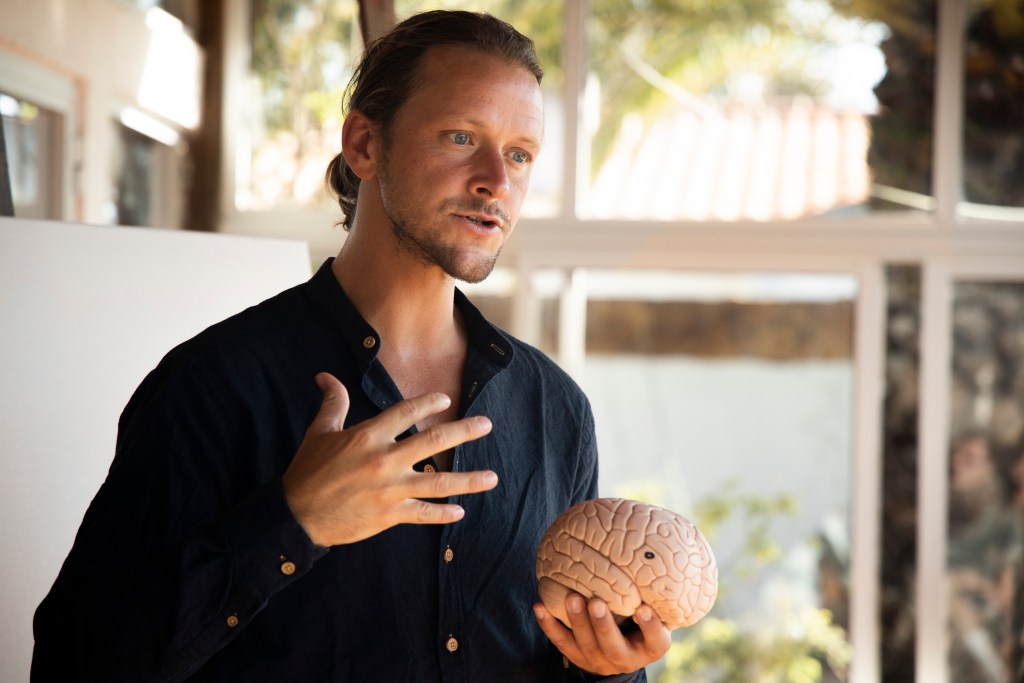
Dr Mendel Kaelen, founder of Wavepaths, is internationally recognised for pioneering research on the therapeutic power of music. In this course, he shares the essence of more than 15 years of research and practice.
He completed his PhD in neuroscience at Imperial College London in 2017, specialising in the role of music in psychedelic therapy. He has co-authored more than 50 academic papers and is widely regarded as a thought leader in this field.
His platform, Wavepaths, has supported over 50,000 clinical sessions. He also has had an active and diverse music practice for several decades, has guided hundreds of group and individual sessions, and curated therapeutic playlists that have reached more than 100,000 listeners worldwide.
Independent | On-Demand
Ideal for those who prefer autonomy and self-paced study, while still developing new foundations in therapeutic music.
Access from January 2026
Live | Interactive | Guided
Ideal for those who value real-time dialogues, personalised feedback and deeper experiential learnings.
Independent | On-demand
Pre-recorded content for those who prefer autonomy and self-paced study, whilst still developing new foundations in therapeutic music.
Access from 15 January 2026
Opportunities to work directly with Mendel, during or after this course, will be released in December.
You will be introduced to the key structures, tools, and methods that will guide you through this course. We will explore the three core competencies in more context, outline what lies ahead, and begin connecting with your teacher Mendel and your fellow participants. These live meetings are only accessible for the live cohorts
We begin by exploring music as a foundational aspect of human consciousness rather than a cultural accessory. Key questions we'll address: What is music, and how is it different from sound? How did music emerge in human evolution, culture, and development? Why has music played such a central role across societies, rituals, and healing practices? What may have been lost in modern relationships with music, and what can be regained? This phase introduces music as a transformative technology, a non-verbal language, and a core mediator of intersubjective experience.
This module introduces the concept of the musical self: the internalised patterns through which individuals perceive, use, and respond to music. Key questions we'll address: How does the self develop through sound, rhythm, and musical qualities? What is innate versus culturally shaped in musical experience? How do musical preferences, aversions, and habits reflect deeper psychological structures? How do people actively use music to regulate, transform, and express themselves? Participants engage in reflective practices to explore their own musical histories and patterns of listening.
Here the focus shifts from music as an object to listening as an active, embodied process. Key questions we'll address: How does sound become music in the brain? How does music become a lived, multi-sensory experience? How does music engage body, emotion, imagery, memory, and thought simultaneously? What distinguishes different modes of listening, including deep and immersive forms? This phase lays the groundwork for understanding how music can become therapeutic.
Across two modules, we explore what gives music its unique psychological and experiential character. Key questions we'll address: What musical qualities shape subjective experience? How do intensity, complexity, rhythm, timbre, progression, and structure influence consciousness? How do genre, culture, familiarity, and novelty shape musical impact? How can music support different therapeutic functions such as soothing, deepening, containing, or resolving? This module introduces a meta-model for understanding musical effects beyond genres or playlists.
Here, we will explore what gives music its unique psychological and experiential character. Key questions we'll address: What musical qualities shape subjective experience? How do intensity, complexity, rhythm, timbre, progression, and structure influence consciousness? How do genre, culture, familiarity, and novelty shape musical impact? How can music support different therapeutic functions such as soothing, deepening, containing, or resolving? This module introduces a meta-model for understanding musical effects beyond genres or playlists.
Music is explored as an active agent within therapeutic processes. Key questions we'll address: What therapeutic functions can music serve? How do intentions, goals, and therapeutic directions shape musical decisions? What roles can music play (e.g. medicine, mirror, relational field)? How do cultural, individual, and contextual factors influence these roles? This phase integrates psychological theory with experiential understanding.
You'll learn how musical experiences are shaped by preparation, context, and relational dynamics. Key questions we'll address: How do we prepare individuals or groups to work with music? What makes a therapeutic environment supportive of musical work? How do rituals, boundaries, and language influence musical impact? What supports meaningful integration after music-centred experiences?
This one-month Playlist Design Workshop brings your learning into direct practice. Within triads and small groups, you’ll explore and experience each other’s playlists and approaches. This is the playground where you have the opportunity to experiment with your ways of interviewing, personalising, sequencing, mixing, and adapting music. You will learn by doing, listening, and reflecting. And in sharing the creative fun of this all together.
Here we will pull together the threads of our learning. We take time to revisit the frameworks, principles and practices explored throughout the course, and together draw connections and transitions into our practices. This final stage is both a shared closure and beginning: a moment to recognise your growth, articulate your direction, and carry this work forward with clarity and confidence. We will consider and offer various ways for alumni to stay connected and informed. These meetings are only accessible for the live cohorts.
All the live sessions are happening via zoom, whereas all recorded lectures, written materials, practice guidance, and community spaces will be accessible via a private portal.
We recommend to dedicate a minimum of 1-1.5h per week, and an ideal of 2–4 hours per week, combining theoretical exploration, experiential listening, and reflective practice. The pace is designed to integrate well alongside your professional and personal commitments.
You need a device to access the zoom sessions and/or recordings, and just a pair of headphones or speakers. If you have an eye-mask, that is great. Any additional tools and recommendations will be introduced during the course, with guidance on how to use them most effectively.
All lectures are recorded and made available to you afterwards. You’ll be able to follow along at your own pace and revisit key moments as often as you wish.
Yes. You will retain access to all recorded content and resources for at least 12 months online, allowing you to revisit and deepen your learning over time. In addition, you will receive a digital handout, an e-book summary of all core materials covered during the course.
Participation is always encouraged and never mandatory. You can engage as actively or privately as feels right.
All sessions and materials are in English.
You will receive a Certificate of Completion. CE accreditation is currently in progress, and participants will be notified as soon as it becomes available.
The course is designed to suit any profession that offers a care- or therapeutic service, and is interested in introducing or deepening the use of music in this practice. Therefore, psychotherapists, psychedelic therapists, hospice care, body-mind practitioners such as breathworkers, teachers, coaches and guides - are all welcome to join and form a collaborative, diverse learning collective.
Not at all. The focus on the development of therapeutic musicality does not require any musical skill, instrument played, or knowledge of music theory.
Absolutely. This course in fact encourages you to bring your own musical landscape into the learning process. You’ll be guided to explore, expand and work with music that resonates with your own musical personality.
A 100%. While the course is not explicitly focused on any specific psychedelic medicine, it provides a new approach to and a strong foundation for the use of music in these contexts.
Yes, plenty! You’ll experience a wide variety of musical examples across genres, styles and cultures, while simultaneously acquiring new modes of listening.
Very much so. Ethical integrity, safety, and cultural sensitivity are woven throughout the course. You’ll learn how to work with music responsibly, especially when supporting clients in vulnerable or expanded states of consciousness.
This training bridges scientific research, psychotherapy theory, and experiential music practices. It integrates a number of disciplines into a coherent framework for the therapeutic application of music. In fact, the majority of these teaches are introduced for the first time publicly within the 2026 January-April Cohorts.
Absolutely. Many practitioners enter this course with already an established musicality, a set of intuitive skills, or credentials in music therapy. What they will gain are new ways of understanding, enriching and using these in practice.
The course creates a gentle and confidential space where you can participate at your own pace, and as much and as little as you want.
This course will be a starting point, a catalyst for a renewed relationship to music and listening itself. Whether in therapy, work, or daily life, you will likely find yourself to be more attuned, intentional, and aware of the dimensions of sound, music and human experience.
If you are curious to explore ways to introduce or deepen the use of music in your practice, this is an ideal learning environment for you. The course gives you both a new understanding and a lived confidence in therapeutic music. You will be part of an emerging new wave of care-providers that like to expand their awareness and repertoire of offering experiences that are most impactful and meaningful.
© 2024 All Rights Reserved • Wavepaths